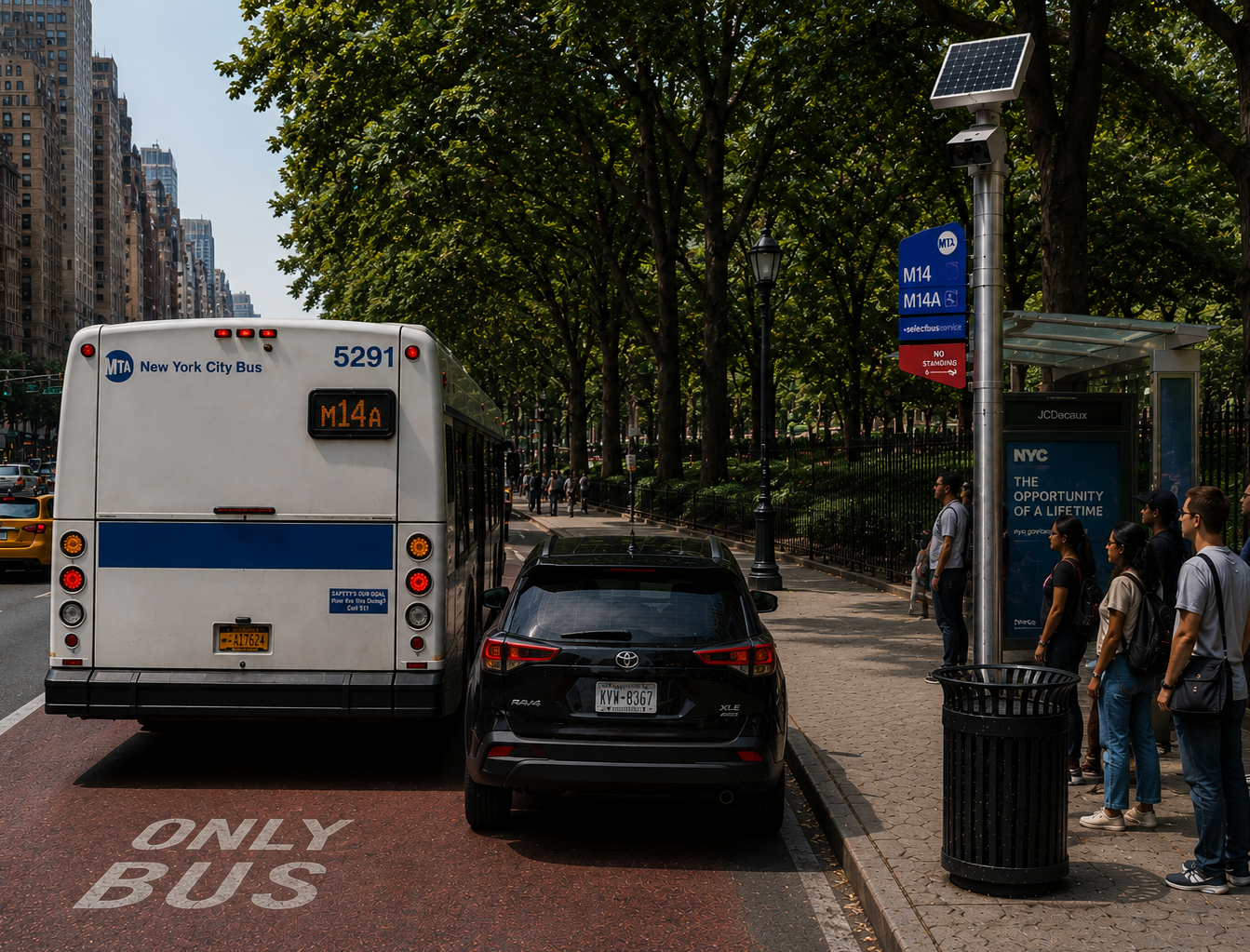
A blocked stop forces a bus to board from the traffic lane. Ramps cannot deploy, boarding slows, the schedule slips, and passengers who depend on level access are affected first. SaferSmart Zones helps identify and document defined events in the marked transit zone and supports the review workflow that follows.
Truth at the Curb: Transforming Every Bus Stop into a Source of Operational Intelligence
A bus stop is far more than a place where passengers board a vehicle.
It is where buses merge into traffic, where passengers interact with public infrastructure, where accessibility must be maintained, and where a single illegally parked vehicle can delay an entire route.
For most transit agencies, however, the curb remains one of the least understood parts of the transportation network.
While agencies have detailed information about vehicle location, schedule adherence and fleet performance, they often lack reliable data about what is actually happening where service begins—the curb itself.
Safer Smart Zones™ changes that.
Using intelligent, AI-powered curbside cameras, the platform delivers Truth at the Curb™—a continuous layer of operational intelligence that helps transit agencies improve safety, increase reliability, protect transit priority infrastructure and make better planning decisions from real-world curb activity.
The Challenge
Transit agencies invest millions of dollars in dedicated bus lanes, accessible boarding areas, transit signal priority and passenger infrastructure.
Yet these investments are frequently undermined by everyday curbside activity.
Vehicles stop in bus zones.
Delivery vehicles occupy loading areas during peak periods.
Drivers block accessible boarding pads.
Ride-share vehicles interrupt passenger loading.
Traffic congestion forces buses to merge unpredictably into traffic.
Each individual event may seem minor.
Across an entire network, however, these recurring disruptions contribute to delays, reduced schedule reliability, accessibility challenges and increased operational costs.
Traditional enforcement cannot realistically monitor thousands of bus stops every day, leaving agencies with limited visibility into how frequently these issues occur or where resources should be focused.
Truth at the Curb™
Safer Smart Zones provides transit agencies with a new layer of operational awareness by transforming existing or newly deployed cameras into intelligent curbside sensors.
The platform continuously analyzes activity around bus stops using computer vision and artificial intelligence to understand how curb space is actually being used.
Rather than simply recording video, SSZ identifies meaningful operational events, including:
- Vehicles stopped in designated bus stops
- Unauthorized use of dedicated bus lanes
- Blocked accessible boarding areas
- Passenger loading and unloading activity
- Traffic conditions affecting bus arrivals
- Dwell time trends
- Vehicle movements around transit infrastructure
The result is a living operational picture of every monitored stop.
Instead of relying on occasional field observations or customer complaints, agencies gain objective data that supports both day-to-day operations and long-term planning.
Supporting Enforcement and Compliance
Keeping bus stops and dedicated transit lanes clear is essential to maintaining reliable service.
When buses cannot access designated curb space, passengers must board from active traffic lanes, accessibility can be compromised, and schedules quickly begin to deteriorate.
SSZ can automatically identify vehicles occupying restricted transit infrastructure and generate evidence packages for review by authorized enforcement personnel.
Because the platform is hardware agnostic, compatible existing municipal traffic cameras or dedicated SSZ cameras can be integrated into the same centralized platform, allowing agencies to expand monitoring without replacing existing infrastructure.
The goal is not simply issuing citations.
Visible, consistent enforcement encourages better driver behaviour, helping keep transit lanes available for the vehicles they were designed to serve.
Data That Improves Transit Operations
Every interaction at the curb generates valuable operational information.
By aggregating these observations across hundreds or thousands of stops, SSZ creates a powerful planning resource for transit agencies.
Agencies can better understand:
- Which stops experience recurring illegal parking
- Where buses experience the greatest boarding delays
- Peak congestion periods around transit infrastructure
- Accessibility challenges affecting passengers
- Compliance with transit priority regulations
- Locations where infrastructure improvements may be required
These insights support evidence-based investment decisions, allowing agencies to prioritize improvements where they will have the greatest operational impact.
Improving Passenger Safety
Passengers should never be forced to board from traffic because a bus stop is blocked.
Nor should operators be required to merge unpredictably into active traffic because curb access is unavailable.
By improving compliance around transit infrastructure, Safer Smart Zones helps create safer boarding environments for passengers, reduces conflicts between buses and surrounding traffic, and supports more predictable transit operations.
For agencies pursuing Vision Zero, Complete Streets and public transit reliability initiatives, better curb management becomes an essential component of safer urban mobility.
Building Smarter Cities Through Better Curb Intelligence
Cities are increasingly recognizing that the curb is one of their most valuable—and most contested—pieces of infrastructure.
Transit vehicles, cyclists, delivery services, taxis, ride-share operators and private vehicles all compete for the same limited space.
Truth at the Curb™ provides the objective data needed to manage that space intelligently.
With AI-powered monitoring, scalable hardware-agnostic deployment and actionable operational analytics, Safer Smart Zones helps transit agencies move beyond reactive enforcement toward proactive network management.
The result is more reliable service, safer passenger experiences, better accessibility and smarter transportation planning—all powered by a clearer understanding of what is happening at the curb.
Because better transit begins where every trip starts: at the curb.
Supporting Research
Federal Transit Administration – Bus Stop Design and Safety Resources
https://www.transit.dot.gov/
Provides guidance on accessible bus stop design, passenger safety and transit operations.
National Association of City Transportation Officials (NACTO) – Transit Street Design Guide
https://nacto.org/publication/transit-street-design-guide/
Demonstrates how keeping bus stops and transit lanes clear improves transit reliability, passenger safety and accessibility.
Transportation Research Board – TCRP Report 165: Transit Capacity and Quality of Service Manual
https://www.trb.org/Main/Blurbs/171718.aspx
Documents the relationship between curb operations, dwell times, service reliability and passenger experience.
Federal Highway Administration – Complete Streets Resources
https://highways.dot.gov/safety/other/complete-streets
Highlights safer street design, multimodal transportation and curb management principles.
Institute of Transportation Engineers (ITE) – Curbside Management Practitioner Guide
https://www.ite.org/
Explores curb management strategies, competing curb demands and the importance of data-driven curb operations.
International Transport Forum – Managing the Curb
https://www.itf-oecd.org/managing-curb